
Building a successful FX trading strategy is not about discovering a secret formula that predicts every movement in the currency market. A strong strategy is a structured decision-making process that combines market analysis, risk management, discipline and the ability to adapt when conditions change.
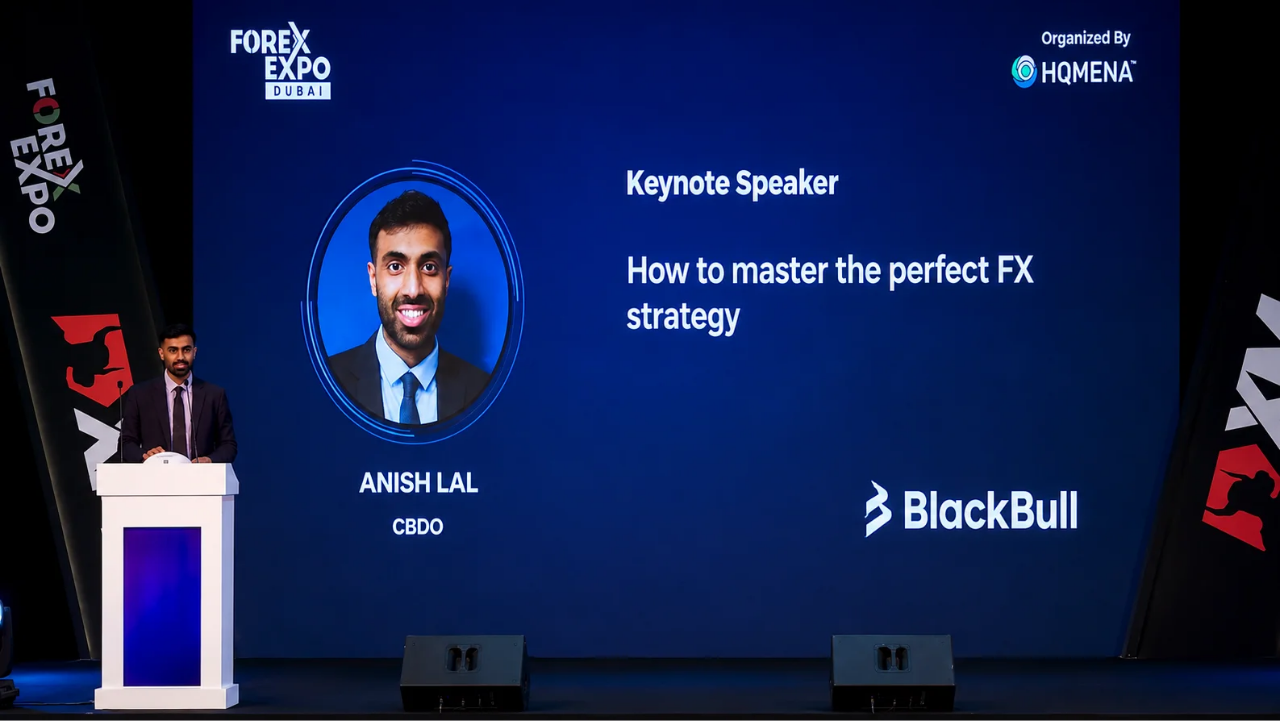
At Forex Expo Dubai, Anish Lal took the stage as a keynote speaker to discuss how traders can approach the challenge of mastering an effective FX strategy. The subject is particularly relevant in a market where participants are constantly exposed to changing economic conditions, volatility and large amounts of information.
One of the most important principles behind any trading strategy is having a clearly defined process. Entering the market without a plan can turn trading into a series of emotional decisions rather than a disciplined activity.
A structured strategy should help a trader understand why a position is being considered, what conditions need to be present before entering, where the trade becomes invalid and how much capital should be exposed.
This preparation becomes especially important in foreign exchange because currencies can respond rapidly to economic data, central bank decisions, geopolitical developments and changes in global risk sentiment.
No strategy can remove this uncertainty.
Instead, an effective approach should provide a framework for making decisions while uncertainty exists.
Risk management therefore becomes one of the foundations of sustainable trading.
Traders naturally focus on potential profits, but professional decision-making also requires considering what happens when the market moves in the opposite direction.
Before entering a position, a trader should understand the amount of capital at risk and whether that exposure is appropriate relative to the overall account.
This helps prevent one unsuccessful trade from having a disproportionate impact on long-term performance.
Position sizing is closely connected with this principle.
Even a strong trading idea can become dangerous when excessive exposure is used.
A trader can have a reasonable market view and still experience a poor outcome if risk has not been controlled appropriately.
This is why successful trading should not be judged only by whether an individual trade wins or loses.
The quality of the process behind the trade is equally important.
Analysis is another major component of an FX strategy.
Technical analysis allows traders to examine price behaviour, trends, support and resistance areas, momentum and other information derived from market activity.
Fundamental analysis approaches the market from another perspective.
Interest rates, inflation, employment, economic growth and central bank policy can influence currencies over different time horizons.
Neither approach needs to exist completely independently.
Many traders use a combination of technical and fundamental information to develop a broader understanding of market conditions.
For example, fundamental analysis may help a trader understand why a currency could experience sustained pressure, while technical analysis may provide additional context for timing and risk management.
The important point is consistency.
Constantly changing analytical methods after every losing trade can make it difficult to determine whether a strategy actually has an edge.
A trader needs enough observations to evaluate how a particular approach behaves across different market environments.
This is where testing and reviewing become valuable.
Keeping records of trades can help identify patterns that are difficult to notice when decisions are evaluated individually.
A trading journal can record the reason for entering a position, the market environment, risk taken, outcome and any mistakes made during execution.
Over time, this information can reveal whether certain setups perform better than others.
It can also expose behavioural problems.
A trader may discover that losses are frequently larger when positions are entered impulsively, when risk limits are ignored or when trading continues after a frustrating result.
These insights can be just as valuable as discovering a profitable technical setup.
Trading psychology therefore cannot be separated from strategy.
A trading plan may look excellent on paper but still fail if the trader cannot follow it consistently.
Fear can cause traders to exit positions too early.
Greed can encourage excessive exposure.
Frustration can lead to revenge trading.
Overconfidence after several successful trades can result in unnecessary risk.
The purpose of a structured strategy is partly to reduce the influence of these emotions.
Rules create a framework that traders can refer to when markets become stressful.
Patience is another important part of the process.
A trader does not need to participate in every market movement.
Some conditions may fit a strategy particularly well, while others may provide very little advantage.
Waiting for appropriate conditions can therefore be an active trading decision rather than inactivity.
This distinction is important because modern trading platforms make it extremely easy to enter and exit positions.
Ease of execution can sometimes encourage unnecessary trading.
More trades do not automatically produce better results.
The quality of opportunities matters more than simply remaining active.
A well-developed FX strategy should consequently define situations where no trade should be taken.
This can include periods of unusual volatility, unclear market structure or circumstances where the potential reward does not justify the risk.
Understanding when not to trade is often an overlooked part of strategy development.
Market conditions also change.
A method that performs effectively during a strong trend may behave very differently when the market becomes range-bound.
Similarly, strategies designed for relatively stable conditions may experience difficulties during major economic announcements or unexpected geopolitical events.
Adaptability therefore matters.
However, adaptability should not mean abandoning a strategy whenever a trade loses.
There is an important difference between making evidence-based adjustments and reacting emotionally to short-term results.
Trading inevitably includes losses.
Even a strategy with a genuine statistical advantage can experience periods where several trades fail consecutively.
This is why traders need realistic expectations.
The objective is not perfection.
The objective is to develop a process where risk is controlled and profitable opportunities can potentially outweigh unsuccessful decisions over time.
Risk-to-reward considerations can help traders evaluate this relationship.
A strategy does not necessarily require an extremely high percentage of winning trades if successful positions are meaningfully larger than average losses.
Conversely, a strategy with a high win rate can still perform poorly if occasional losses are allowed to become excessively large.
The relationship between win rate, average profit and average loss therefore deserves careful attention.
Execution is another important element.
A trading idea only becomes a real position when an order reaches the market.
Traders should understand how different order types operate and how market conditions can influence execution.
Periods of high volatility can produce rapid price changes, wider spreads and differences between expected and actual execution prices.
These factors should be considered when developing realistic expectations around a strategy.
The trading environment itself also matters.
Reliable technology, access to relevant markets and clear information about trading conditions all contribute to the practical implementation of a strategy.
This is particularly important for active traders, where small differences in execution or transaction costs can become more significant over a large number of trades.
At the same time, technology should remain a tool rather than a substitute for decision-making.
Indicators, automated systems and sophisticated platforms can process information quickly, but traders still need to understand the assumptions behind the tools they use.
Adding more indicators does not automatically improve a strategy.
In some cases, excessive information can make decision-making more difficult.
A simpler framework that a trader understands thoroughly can be more useful than a complicated system that produces conflicting signals.
Clarity is therefore valuable.
A trader should ideally be able to explain the logic of a strategy without relying on vague assumptions.
What market behaviour is the strategy attempting to capture?
What creates the entry?
Where is the risk defined?
Under what circumstances should the trade be exited?
When should the strategy remain inactive?
Answering these questions helps transform a trading idea into a repeatable process.
Time horizon also influences strategy design.
A short-term trader may focus heavily on intraday price behaviour and immediate liquidity conditions.
A swing trader may hold positions for several days and place greater emphasis on broader technical structures and upcoming economic events.
Longer-term currency strategies may be influenced more heavily by macroeconomic trends and monetary policy.
There is no single time horizon that is appropriate for every trader.
The strategy should fit the trader’s objectives, experience, available time and tolerance for risk.